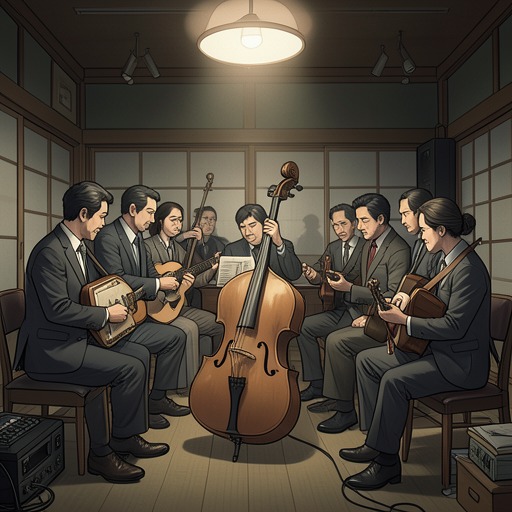
Mrs. Ide
The Earthquake BirdMrs. Ide is a violinist in the small Tokyo music group that takes Lucy on as its new cellist. Introduced through her warm greeting and shared playing, she becomes more than a member of Lucy’s new ensemble when she recounts a childhood journey from Manchuria to Japan: a long walk guided by stars, during which her younger sister disappeared. The contrast between the group’s attentive musical union and Mrs. Ide’s unresolved family loss gives her brief appearance particular weight.
Identity and Introduction
Mrs. Ide plays second violin alongside Mrs. Yamamoto, who plays violin, and Mrs. Katoh, who plays viola. The three women had played together for several years before their former cellist died of a brain tumor. When Natsuko tells Lucy that the group is looking for a cellist, the women agree to welcome her; Mrs. Yamamoto offers space in her spare bedroom so Lucy will not have to carry the instrument across Tokyo every week.
Lucy meets Mrs. Ide at Mrs. Yamamoto’s home. She is seated with Mrs. Katoh at the far side of a low table in the sunlit tatami room. Mrs. Ide is stocky, with a round face and a pudding-bowl haircut, and greets Lucy with a broad smile. Lucy answers with a slight bow. The exchange is brief, but establishes a welcoming group in which introductions and shared music matter more than elaborate conversation.
Place in the Music Group
The rehearsal moves from the tatami room to Mrs. Yamamoto’s Western-style living room, where the players can sit in chairs. Mrs. Yamamoto sets out the music stands, leads scales and basic studies, and then gives the group Haydn. The women stop when she frowns, repeating sections and phrases until they find their shared meaning. They hardly speak, yet the work of listening draws them together.
Lucy is initially out of practice and misses some sharps and flats, but the others do not criticize her. After lunch they play Mozart until sunset, with wrong notes, uncertain rhythms, and sections that remain unarticulated. The performance is not professional, but Lucy recognizes the beauty of the women’s playing together and gradually feels herself take a full place in the ensemble. Mrs. Ide’s part in this scene is not singled out as a solo display; her significance lies in the collective practice she helps sustain, where each player has to listen for the others.
Childhood and Displacement
After the music, Mrs. Ide tells Lucy about her early life. She was born in Manchuria just before the Pacific War, but remembers nothing of the war itself. In its aftermath, her family had to return to Japan. They walked hundreds of miles toward the coast at night, without a map or compass, using the stars to find their way to the Yellow Sea.
Her younger sister did not complete the journey. She disappeared along the way, and Mrs. Ide was never told where she had gone or why. The account offers no resolution or explanation: the sister’s fate remains an absence in the family story. By placing this history after a long, largely wordless rehearsal, the narrative sets an intimate act of collective attention beside a childhood experience in which a family member was lost and the reason was withheld.
Narrative Significance
Mrs. Ide’s brief biography brings the history of displacement into Lucy’s new social world in Tokyo. Her childhood return from Manchuria is described through concrete means of survival—the night journey, the lack of map and compass, and the stars that served as a guide—while the disappearance of her sister remains unexplained. The story distinguishes what Mrs. Ide can recount from what she was never told, leaving the loss present without supplying an invented conclusion.
The rehearsal gives that disclosure a particular context. The musicians find their way through Haydn by stopping, listening, and trying phrases again until they can play them together; Mrs. Ide’s account, by contrast, cannot be completed into a settled explanation. Her role therefore joins two forms of shared attention: the patient listening that makes the ensemble possible and the personal history she entrusts to Lucy after the playing ends. The scene presents her not only as one of the older women who makes room for a younger cellist, but also as a person whose life carries an unresolved history of return and separation.